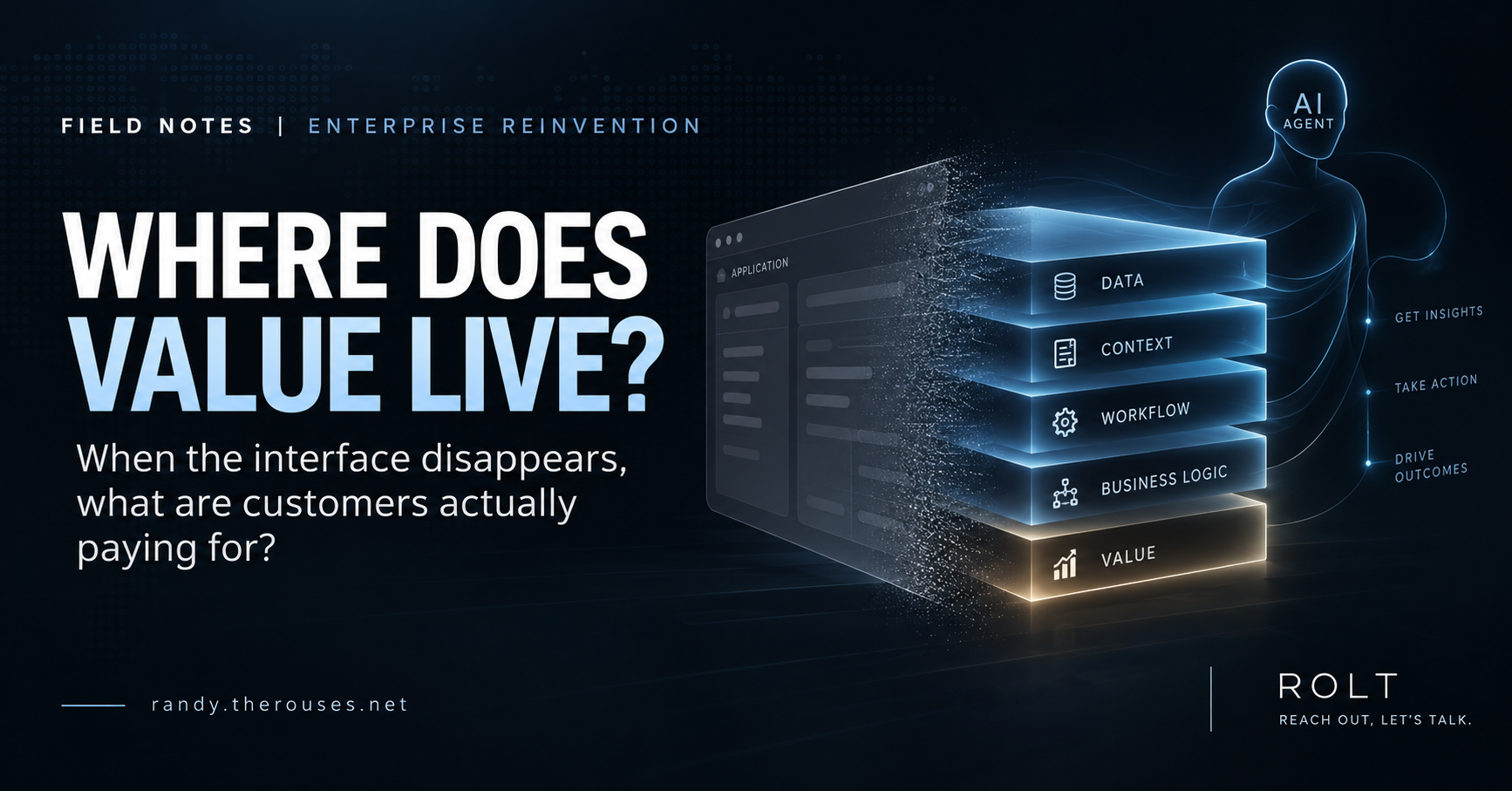
FIELD NOTES | ENTERPRISE REINVENTION
AI may not kill enterprise software. But it may change what customers are actually paying for.
If your customers stopped opening your application tomorrow but doubled the amount of work flowing through your platform, would your business get stronger or weaker?
I've been thinking about that question a lot lately.
For decades, enterprise software had a pretty straightforward relationship between value and usage.
A person needed to accomplish something. They opened an application. They used the features. As more people needed access, the company bought more licenses.
The interface wasn't just how customers used the product. It became part of how we measured and monetized the value of the product.
AI agents are starting to pull those things apart.
The user may never open the application.
The work may still happen.
And the data, business rules, permissions and workflows underneath the application may become more important than the screen itself.
That creates a question I think every enterprise software company eventually has to answer:
Where does the value actually live?
What if the application stops being the destination?
Salesforce gives us one of the clearest examples of what's changing.
Earlier this year, Salesforce co-founder Parker Harris asked a pretty remarkable question:
“Why should you ever log into Salesforce again?”
Think about that for a second. This is Salesforce asking whether customers actually need to be in Salesforce.
Its Headless 360 architecture is designed to turn Salesforce applications into capabilities that authorized agents can discover and use. The data, permissions, workflows, governance and business logic can remain inside Salesforce.
The interface doesn't have to.
A customer could potentially consume more Salesforce while spending less time actually using Salesforce.
For years, enterprise software companies fought to become the screen where work happened.
Now one of the largest software companies in the world is asking whether you need to see the screen at all.
I don't think that's a retreat.
I think it's a clue.
The interface and the capability are separating
There's been plenty written about AI killing SaaS.
I think that's the wrong question.
Something more interesting is happening.
AI isn't necessarily destroying enterprise software. It's separating the value of the software from the screen through which humans historically consumed it.
The application may become less visible while what's underneath it becomes more important.
CRM still needs customer records.
ERP still needs financial rules and transactions.
HR still needs organizational data, policy and workflow.
Those things don't disappear because an agent becomes the interface.
The agent still needs somewhere to get trusted data and context. It still needs business rules. It still needs permissions. And ultimately, it needs systems capable of actually doing something.
HubSpot is making a version of that argument with what it calls "Growth Context."
Its strategy combines customer, business and team context to improve what AI can actually accomplish. HubSpot says customers using AI with high-quality context generated 3.6 times more marketing-qualified leads, won 3.2 times more deals and closed more than twice as many tickets than its comparison group.
Those are HubSpot's numbers, so I'd treat them accordingly.
But the direction is interesting.
The model can change.
The interface can change.
The business context underneath them is much harder to replace.
Which leads to the bigger question:
What business are you actually in?
We've seen this question before
Technology history is full of companies that saw the next technology coming and still struggled with what it meant for their business.
That's an important distinction.
Salesforce isn't Kodak. Workday isn't BlackBerry. Today's enterprise software market isn't Blockbuster in 2005.
I'm not comparing the companies.
I'm comparing the question they eventually have to answer.
When the way customers receive value changes, which part of your existing business is actually worth protecting?
Kodak understood digital photography technically. The much harder problem was what digital photography meant to a company whose economics were built around film.
BlackBerry understood mobile communications. What changed was what customers expected a smartphone to be.
Blockbuster certainly understood that people wanted movies. What changed was how people expected to get them.
The lesson isn't that successful companies can't see change coming.
The harder problem is recognizing when the thing that made the existing business successful is no longer the thing customers value most.
That matters in enterprise software right now.
What happens to the seat?
For most of the SaaS era, the seat made a lot of sense.
One person. One license.
Add employees, add users, add seats.
Software revenue could grow alongside customer headcount and adoption.
Agents complicate that equation.
Imagine an agent performing work previously spread across five, fifty or five hundred people.
How many seats is that worth?
Workday has been unusually direct about this.
The company says the traditional per-seat model is moving toward a hybrid model involving consumption and outcomes. Workday CTO Gabe Monroy put it this way:
“The value is no longer derived by a fixed factor, like how many employees you have working for you. It's now going to be derived by how much use are you getting out of the system, hence the consumption.”
The subscription hasn't disappeared.
There's just another meter sitting next to it.
HubSpot makes the change even easier to see.
Its subscription still includes seats. But some AI work is measured separately through credits.
Customer Agent, for example, consumes credits when it resolves a conversation without human assistance. HubSpot doesn't charge based on how many messages the agent exchanged. It charges for the resolution.
HubSpot describes the model pretty plainly:
“You only pay when the work is done.”
That's a meaningful change.
The customer isn't paying because another person logged in.
They're paying because the software did some work.
The seat may become the admission ticket. The work becomes the meter.
I don't think the seat is going away.
People will continue using applications. Companies still want predictable subscriptions. And plenty of software value will continue to be tied directly to human users.
But the seat may lose something it has enjoyed for decades:
its monopoly on how we measure software value.
From access to work to outcome
I think there's a progression underneath this.
Access: I pay because someone can use the software.
Work: I pay because the software did something.
Outcome: I pay because what it did produced a result I value.
All three can exist at the same time.
That's probably a more realistic near-term future than declaring seat-based SaaS dead.
Platform subscription.
Human access.
Machine consumption.
And in some cases, an outcome.
Gartner estimates that as much as $234 billion in enterprise application SaaS spending could be exposed to what it calls “agentic arbitrage” by 2030, roughly 20% of the market. Its explanation is remarkably close to what we're seeing here: agents can bypass traditional application interfaces and break the historical connection between user growth and revenue growth.
That's a huge number.
But I wouldn't read it as $234 billion of SaaS disappearing.
The more interesting possibility is that some of that value moves.
Software doesn't necessarily lose its value because it becomes invisible.
The vendor has to figure out how to capture the value when it does.
Customers may tell us before revenue does
This may be the signal I'd watch most closely.
Revenue is usually late.
Customer behavior changes first.
Customers may start caring less about how many people logged in, how many screens they used, or how many features they activated.
And start caring more about how much work the system performed, how many cases it resolved, how many transactions it processed, how much time it saved, and what the outcome cost.
That's when you should pay attention.
The first sign your business model is changing may not be lost revenue. It may be customers finding a new way to consume your value.
Imagine application logins falling while API calls, agent transactions and automated workflows explode.
Is the product dying?
Maybe.
Or maybe it's becoming infrastructure.
Those can look surprisingly similar if you're watching the wrong metric.
The difference is whether the value, and the economics, followed the capability out of the UI.
The companies already here may have an advantage
There's an easy version of this story where AI startups sweep away traditional enterprise software.
I'm not convinced it's that simple.
The established software companies already have things agents need.
Data. Business rules. Permissions. Workflow. Transaction history. Years of integration into how companies actually operate.
That's a pretty good hand to play.
The question is whether those companies recognize which cards actually matter.
If the screen becomes less important, defending the screen isn't necessarily the answer.
Maybe you expose more of the capability underneath it.
Maybe you change what you meter.
Maybe you let someone else's AI become the interface.
We're already seeing pieces of all three.
Salesforce is making applications available as capabilities.
Workday is changing how machine work gets measured.
HubSpot is separating human access from agent consumption.
Different approaches to the same underlying question:
Where does the value live when the customer no longer has to use the product the way they used it before?
The Boardroom Questions
This conversation belongs above the product roadmap.
If I were sitting with a leadership team, these are the questions I'd want on the whiteboard:
If our customers stopped opening our application tomorrow but doubled the amount of work flowing through our platform, would our business get stronger or weaker?
Which parts of our product remain valuable if the interface disappears?
Are customers paying us for access, for work performed, or for an outcome?
What customer behavior would tell us the unit of value is changing before revenue tells us?
If we had to disrupt our own pricing model before somebody else did it for us, what would we change?
Those aren't comfortable questions.
That's probably why they're worth asking.
Reinvention starts before the numbers force it
I don't think enterprise applications are disappearing.
The interface, the capability and the way we charge for value are starting to separate.
Agents can become the interface.
Applications can become infrastructure.
A human login may no longer tell us how much of the product a customer is actually consuming.
And the data, context, workflows, permissions and business logic underneath the application may become more valuable as customers interact with them less directly.
That's a risk for established software companies.
It's also an opportunity.
Reinvention doesn't always mean abandoning the business you've built.
Sometimes it means figuring out which part of that business your customers were actually paying for in the first place.
Where does your value live?
Reach Out, Let's Talk.
Sources
- Salesforce, Headless 360 / enterprise capabilities: https://www.salesforce.com/news/stories/expanding-headless-360-enterprise-capabilities/
- Salesforce, Headless 360 announcement: https://www.salesforce.com/news/stories/salesforce-headless-360-announcement/
- HubSpot Fall 2026 Spotlight: https://ir.hubspot.com/news-releases/news-release-details/fall-26-spotlight-hubspot-just-made-its-most-foundational
- Workday usage-based AI pricing: https://blog.workday.com/en-us/usage-based-ai-pricing.html
- HubSpot AI credits: https://www.hubspot.com/products/artificial-intelligence/credits
- Gartner, agentic AI and enterprise SaaS spending: https://www.gartner.com/en/newsroom/press-releases/2026-07-01-gartner-says-us-dollars-234-billion-in-enterprise-application-software-spend-is-at-risk-from-agentic-artificial-intelligence