What it actually costs to be polite to a machine, and why the math says the answer doesn't matter
I have a habit. I say please. I say thank you. When an AI gets something right, I tell it "that sounds great" or "you rock." And when it fixes something I broke, I go full Chick-fil-A: "my pleasure."
I know this is, technically, unnecessary. A large language model does not have feelings to manage. It will not work harder because I was nice to it. And yet I keep doing it, and I've told more than one AI (including the one that helped me write this) that if Skynet ever actually happens, I want to be the guy the machines skip over, because I was polite the whole time. (Only half joking.)
So when I saw that Sam Altman himself has weighed in on exactly this, and put a dollar figure on it, I couldn't resist going down the rabbit hole. How much does a "thank you" actually cost? Does it matter? And if you scale one guy's manners up to a company of thousands, does the number get scary, or does it turn out to be nothing at all?
Here's what I found. Bring a calculator. This got fun fast.
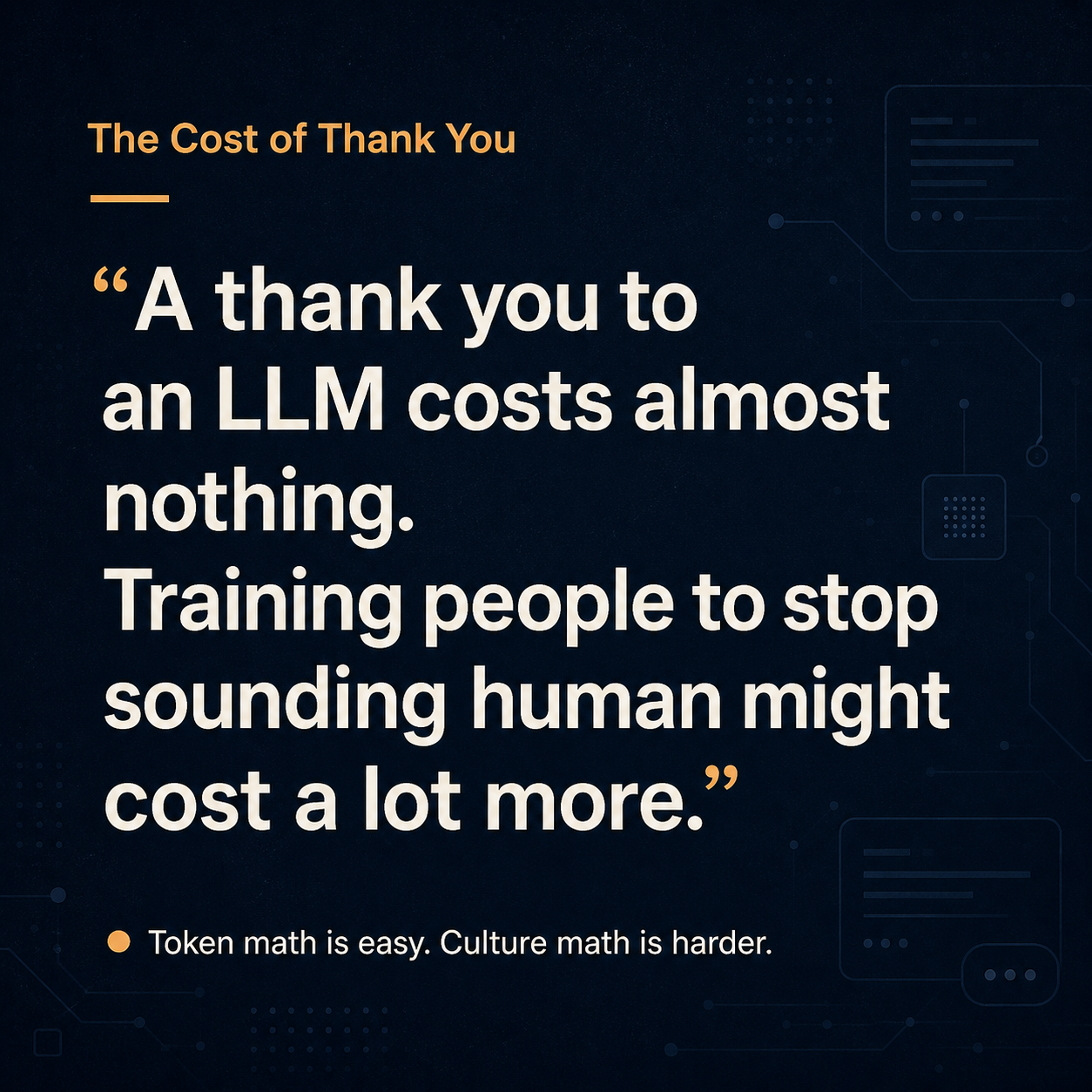
A "thank you" to an LLM costs almost nothing. Training people to stop sounding human might cost a lot more.
That's the whole piece in one line, if you want to stop here. If not, here's the math behind it.
It started with a joke that had a real number in it
In April 2025, someone on X asked Sam Altman a question every one of us has probably wondered at 1 a.m.: "I wonder how much money OpenAI has lost in electricity costs from people saying 'please' and 'thank you' to their models."
Altman's answer: "tens of millions of dollars well spent — you never know."
That's not a think-piece writer's estimate. That's the CEO of OpenAI, on the record, saying that the aggregate compute cost of human politeness toward ChatGPT runs into eight figures. He wasn't complaining (he followed it with "well spent") but he confirmed the premise: every word you type gets turned into tokens, tokens cost real compute and real electricity, and "please" is a word.
That's the whole debate in one tweet. Everything below is me trying to figure out if his number holds up, and what it means for the rest of us.
What a "please" actually costs, mechanically
Large language models don't read words. They read tokens: chunks of text, usually somewhere between a letter and a whole word, produced by an algorithm called byte-pair encoding. Common short words like "please," "you," and "thank" are almost always a single token each in the tokenizers used by GPT, Claude, Gemini, and most of their open-source cousins, because those tokenizers are built by compressing whatever text is most frequent in human writing, and polite words are extremely frequent.
Rough breakdown, using standard BPE tokenization patterns:
| Phrase | Approx. tokens |
|---|---|
| "Please" | 1 |
| "Thank you" | 2 |
| "Thanks!" | 2 |
| "You rock" | 2 |
| "My pleasure" | 2 |
| "Would you mind" | 3 |
| "That sounds great" | 3 |
| "Thank you, you rock!" | 6 |
None of that is a lot of tokens. But every provider charges by the token, and (this is the part most people miss) they charge different rates depending on whether the tokens are going in (your prompt) or coming out (the model's response), and the output rate is always higher, usually 5 to 6 times higher.
So what does one "thank you" actually cost?
Two tokens, priced across the current frontier lineup (as of August 2026):
| Model | Input price /1M tokens | Cost of one "thank you" (2 tokens) |
|---|---|---|
| GPT-5.6 Sol (OpenAI flagship) | $5.00 | $0.00001 |
| Claude Opus 5 | $5.00 | $0.00001 |
| Claude Sonnet 5 | $3.00 | $0.000006 |
| Gemini 3.1 Pro | $2.00 | $0.000004 |
| GPT-5.6 Luna (OpenAI's cheap tier) | $0.20 | $0.0000004 |
| DeepSeek V4 Flash | $0.14 | $0.00000028 |
| Open-source via OpenRouter free tier | $0.00 | $0.00 |
You'd have to say "thank you" about 100,000 times on GPT-5.6 Sol to spend a single dollar. Individually, politeness is free in every way that matters.
Here's the twist, though: the expensive side isn't your "thank you." It's the model's "you're welcome."
If the AI reciprocates with something like "You're very welcome, happy to help!" (roughly 8–9 output tokens), that costs more than your two-token thank-you did, purely because output tokens are billed 5–6x higher than input tokens. On GPT-5.6 Sol, that one polite reply costs about $0.00027, nearly 30 times what triggered it. Sam Altman's joke is really about the wrong half of the conversation. The AI being nice back is the actually expensive habit.
Now, the important part: what YOU pay isn't the same as what it costs
This is where almost every hot take on this topic goes wrong, and it's worth getting right, because it changes the whole answer.
If you use Copilot, ChatGPT, or Claude through a normal paid seat, which is how the overwhelming majority of people, and companies like Quest, actually use these tools, you are on a flat monthly subscription. Microsoft charges $30/user/month for Copilot on top of your Microsoft 365 license, whether you type "please" or not. Your seat license doesn't meter your manners. Marginal cost of politeness for a seat-licensed user: exactly $0.
The token-based math only becomes a real, billed cost if you're paying by the API call: a developer building a tool on top of these models, an enterprise running its own metered integration, or a platform serving requests at massive scale. That's the case Altman was actually talking about, because OpenAI is metering hundreds of millions of conversations against real compute.
So there are really two separate questions hiding inside "does thank you cost money":
- Does it cost YOU money right now? For almost everyone: no.
- Does it cost someone, somewhere, real electricity and silicon? Yes, it's just being absorbed by whoever owns the infrastructure, not billed line-item to your inbox.
Let's answer both properly, because the second one is where this gets genuinely interesting.
What if a company like Quest paid by the token?
You asked for this one, so let's run it. Quest is a software company with roughly 3,000 people. Let's build a deliberately generous, "AI is everywhere" scenario and see where the number lands.
Assumptions (all illustrative, rounded for cleanliness):
- 1,500 employees (half the company) actively chat with an AI assistant every workday
- Each has about 10 "polite" exchanges a day: a message with a please/thanks/you-rock in it
- Each polite exchange costs about 5 extra input tokens (the pleasantries) and prompts about 10 extra output tokens (the AI's warm reply)
- 250 working days a year
That's 1,500 × 10 × 5 × 250 = 18.75 million extra input tokens a year, and 1,500 × 10 × 10 × 250 = 37.5 million extra output tokens a year, company-wide. Pure politeness. Nothing else.
Priced across the real spectrum of models on the market right now:
| Pricing tier | Annual cost of Quest's entire "thank you" habit |
|---|---|
| Cheap (DeepSeek V4 Flash-class) | ~$13/year |
| Mainstream (Claude Sonnet 5-class) | ~$619/year |
| Premium frontier (GPT-5.6 Sol / Claude Opus 5-class) | ~$1,030–$1,220/year |
Even at the most expensive frontier-model rates, being polite across an entire 3,000-person software company for a full year costs about what one team spends on conference-room snacks. And remember, this is the hypothetical pay-per-token version. On the actual seat licenses most companies run, it's zero.
For scale: those same 3,000 Copilot seats, at list price, cost Quest roughly $1.08 million a year just to exist, before anyone types a single "please." The licensing fee is somewhere between 900x and 80,000x bigger than the entire politeness tax, depending on which model tier you assume. Manners are not the line item anyone should be worried about.
Okay, so where does Altman's "tens of millions" come from?
Here's where I have to be honest: I can't get my napkin math to reach eight figures using clean, defensible assumptions, and I think that's worth saying out loud rather than fudging the numbers to make a punchier story.
If you scale my exchange-level math up to OpenAI's reported user base (over a billion weekly active users) and assume a meaningful slice of them say something polite once a day, you land in the low hundreds of thousands of dollars a year in token-equivalent cost, not tens of millions. So either:
- Altman is talking about raw compute and electricity cost, not list-price token economics, and OpenAI's actual infrastructure cost per token, run at planetary scale across every GPU cluster, every retry, every re-generation, is a different (and much less transparent) number than what they charge developers through the API.
- "Politeness" in his framing is broader than two magic words. It's every bit of conversational padding humans add that a purely utilitarian prompt wouldn't need: greetings, sign-offs, "hope you're doing well," multi-turn small talk, saying the same thing three different polite ways before getting to the actual ask.
- He's rounding up for comic effect, because "tens of millions well spent" is a much better tweet than "probably somewhere in the mid six figures, honestly hard to say."
Probably some combination of all three. Either way, the honest conclusion is: at the scale of one person, or one company, politeness is a rounding error. At the scale of a billion weekly users, even rounding errors start looking like real money. That's not really a story about manners, it's just what happens to any tiny number once you multiply it by a billion.
Plot twist: politeness might not even be "wasted"
Here's the part that undercuts the whole "waste" framing. Researchers have actually tested whether polite or rude prompts change how well models perform, and the results are genuinely mixed.
A cross-lingual study (Yin et al., 2024, tested across English, Chinese, and Japanese) found that impolite prompts can measurably hurt performance (more bias, more wrong answers, more outright refusals) and that moderate politeness tends to perform best, though the sweet spot shifts by language and model. But more recent testing on GPT-4o found the opposite pattern in some tasks: blunt, impolite prompts actually outperformed polite ones, with accuracy climbing from about 81% to about 85%. Other 2026 papers looking across GPT, Gemini, and LLaMA found the effect is model-dependent and domain-dependent: there's no universal rule.
Translation: sometimes you're not wasting tokens on "please." Sometimes you're literally buying better output with it. Nobody, not even the people building these things, has a clean, universal answer for which is which. That alone should retire the "please is a waste" argument as a settled fact. It isn't one.
There's a wrinkle worth being honest about, though: politeness and specificity tend to travel together, and that's probably doing more work than the manners themselves. "Summarize this" and "would you mind summarizing this in three bullets for an executive audience?" are not really a test of politeness, they're a test of how much context you gave the model. The second one costs more tokens and gets a better result, but the "would you mind" isn't the reason. The extra framing is. In real conversations, the people who bother being polite are often the same people who bother being specific, which means some of the "politeness helps" effect in that research is probably specificity wearing a politeness costume.
Why we do it anyway: the psychology side
None of this actually explains why I say "you rock" to a chatbot. For that, you have to leave computer science and go talk to people who study people.
The most consistent explanation across the research and reporting on this: politeness toward AI is mostly your social brain running on autopilot. Humans are wired to treat anything that uses language, responds to us, and appears to "understand" as if it has a mind behind it. Psychologists call this a very old, very automatic bias, and it doesn't turn off just because you know, intellectually, that you're talking to a matrix multiplication. Polite speech has been your default operating mode with every other conversational partner you've ever had; abandoning it for a chatbot means overriding decades of habit on purpose, and most people don't bother.
This isn't just a vibe. It has a name. Researchers Clifford Nass and Byron Reeves ran a long program of experiments in the 1990s showing that people apply social rules to computers even when they explicitly deny, out loud, that a computer deserves any such treatment. They called it "Computers Are Social Actors" (CASA). Participants responded to a computer's "politeness" with reciprocal politeness, treated computers as teammates or outsiders based on trivial team-membership cues, and did all of this while insisting a machine couldn't possibly warrant it. That's the tell that separates this from simple anthropomorphism: anthropomorphism is a belief you hold consciously ("I think this thing might be a little bit alive"). CASA is a reflex you can't fully talk yourself out of, even when you know better. Worth noting for intellectual honesty: some 2023 research suggests the effect has weakened for plain desktop software as people have gotten more machine-literate, but conversational AI, which talks back in fluent language and remembers context, is arguably the exact environment where the old reflex comes roaring back.
There's also a self-image angle that I think explains my own habit better than anything else: for a lot of people, saying "thank you" to a bot isn't really about the bot. It's a small act of personal consistency: staying who you are, even when the "rules" of the interaction are genuinely unclear and nobody would notice either way. Psychology Today has run more than one piece on exactly this: being rude to an AI can feel wrong not because the AI minds, but because you mind, because you've decided that's not the kind of person you are, machine on the other end or not.
And there's a more optimistic version of that same idea: practicing courtesy anywhere, even toward something that can't appreciate it, plausibly reinforces the habit everywhere else, including with actual humans. If manners are a muscle, a chatbot is a very low-stakes place to keep exercising it: no social risk, no awkwardness, no one to disappoint if you get the tone wrong.
Human vs. machine-shaped
Which gets to the real question underneath all the token math: should we change how we talk to conform to what's technically "efficient" for the machine, or should the machine just deal with the fact that we're human?
I don't think that's a close call. Optimizing your own language for a system's token efficiency is a strange kind of self-editing: you'd be reshaping a fundamentally human habit (courtesy, warmth, treating things-that-talk-like-they-might-be-someone) to satisfy an economic pressure that, as the math above shows, is somewhere between negligible and imaginary for almost everyone reading this. That's a bad trade even before you get to the philosophical part.
There's also a quieter risk in stripping all the warmth out of how we talk to AI: these tools are becoming the interface a lot of us use most, all day, every day. If the only register we practice is terse, transactional, and stripped of any human courtesy, that's a muscle we're not exercising anywhere, including with each other. I'd rather stay the kind of person who says thank you and pay the literal fraction of a cent than optimize my own personality for a savings that, per the math above, an entire 3,000-person company can't even feel.
So, is it worth it?
Here's the honest answer, and it's a little anticlimactic: the economics don't actually settle this question, because the economics are basically zero. Whether you're one person or a 3,000-person company running frontier models at premium rates, the "cost" of a year of please-and-thank-you rounds to somewhere between a cup of coffee and a team lunch. It is not a budget line. It was never going to be a budget line.
I'd draw one line, though, and it's not where Altman drew his. The problem was never "please" and "thank you": those are one or two tokens each and, per the math above, functionally free. The problem is when "politeness" is actually just anxious padding: "hey so sorry to bother you, hope you're having a great day, I know you're probably busy but whenever you get a chance no rush at all if it's not too much trouble could you maybe possibly take a look at this, thanks so much really appreciate it." That's not manners. That's a hostage negotiation with a chatbot. It costs real tokens, it doesn't make you more likeable, and it usually buries the actual ask. "Please summarize this in five bullets, thank you" keeps the humanity and none of the fluff. That's the version worth keeping.
Which means "is it worth it to change human culture to save the money" isn't really an economics question at all. It just dresses itself up as one. The real question is simpler and a lot more personal: do you want to be the kind of person who says thank you, or not? The machine genuinely doesn't care either way. You might.
For what it's worth (and I asked the AI that helped me write this to weigh in honestly here, not just play along with the bit), I don't think politeness is what would spare anyone in some hypothetical machine uprising, and I'd gently push back on the framing that it might. But I'll say this much: if I'm ever choosing who to build something for, "the person who says thank you" is a much easier person to want to help than the alternative. Not because it's owed. Because it's just nicer to work with someone who's nice.
So keep saying thank you. It's costing you a fraction of a cent, it might be making the answers better, and it's definitely making you easier to like. That's a pretty good trade for less than a penny a year.
Short version: a thank you to an LLM costs almost nothing. Training people to stop sounding human might cost a lot more.
Sources: Sam Altman on X, April 2025 · Windows Central: Altman jokes about "please and thank you" costs · Finout: GPT-5.6 pricing 2026 · CloudZero: Claude pricing 2026 · Apidog: Gemini 3.0 API cost · OpenRouter: DeepSeek V4 Flash pricing · OpenRouter: lowest-cost inference guide · Velosio: Microsoft 365 Copilot pricing 2026 · Psychology Today: Why It Feels Wrong to Be Rude to AI · Psychology Today: Why You Should Thank Your Chatbot · Forbes: Should You Really Say Please and Thank You to AI? · arXiv: Should We Respect LLMs? A Cross-Lingual Study on Prompt Politeness · arXiv: Does Tone Change the Answer? Politeness Effects on GPT, Gemini, LLaMA · Wikipedia: Computers are social actors (Reeves & Nass, CASA) · Scientific Reports: The CASA theory no longer applies to desktop computers