Sunday project. Coffee, a mini PC, and what was supposed to be a quick Plex install.
Three hours later I realized I wasn't learning Docker.
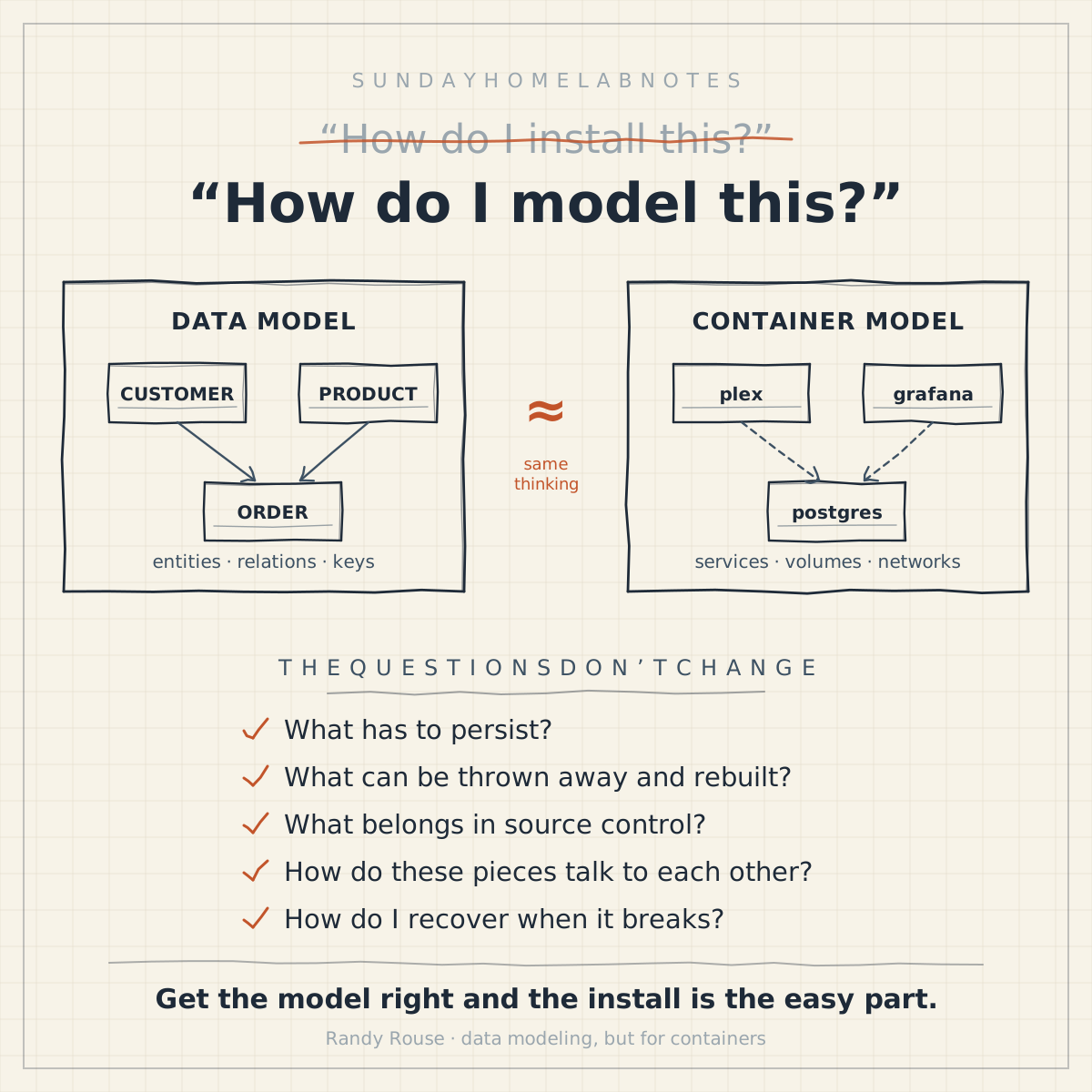
I was learning how to model a platform.
When I started, my question was the one everybody starts with:
"How do I install this?"
Somewhere in there, it changed.
"How do I model this?"
- Where should the data live?
- What's disposable?
- What belongs in source control?
- How do these services talk to each other?
- What happens when the hardware dies?
Sound familiar?
That's data modeling. Same questions, different stack.
A good data model was never just a pile of tables. It's a set of intentional decisions — what the business actually cares about, how things relate, what stands on its own, what's allowed to change.
Turns out a Compose file is the same kind of artifact.
It isn't a deployment script. It's a model of an application:
- What services exist
- How they relate
- What has to persist
- What can be thrown away and rebuilt
- How the whole thing fits together
The technology is different. The thinking isn't.
And the payoff is the same one we chase at work: once the foundation is right — standardized storage, config in version control, repeatable patterns — every new thing is just another workload. Plex, Grafana, Immich, monitoring, AI agents. Same architecture, every time.
At that point I wasn't building a Plex server anymore.
I was building a platform that happens to run Plex.
Not a bad way to spend a Sunday.
Reach Out, Let's Talk.